Blogger Comment: All this is all about making real human robots by changing our cell-like structure to artifical cell-like structures and that will be the real end to humankind, as we know it…as human forms are far better for these insane Globalist elites to use and who are behind the screen controlling all the technology with their financial and economic might and power…for only then will they really control us and will not even need the global surveilance systems then…for we shall not be able to make a single decisions then…full stop…gone
.
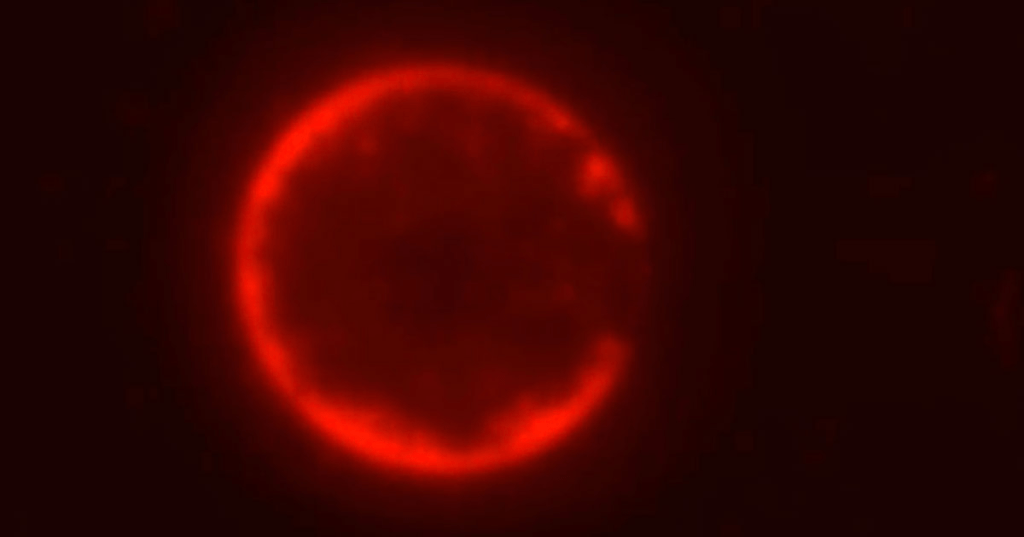
Scientists say they have created a fully synthetic cell that can feed, grow, replicate its genome, and divide, marking a major step toward building life-like systems from non-living chemical components.
The team from the University of Minnesota says its synthetic cell, called “SpudCell,” is the “first synthetic cell with a complete cell cycle.”
Researchers say it can “grow, replicate its genome, divide, and undergo selection and competition across multiple generations.”
The breakthrough could open the door to a new era of biotechnology in which synthetic organisms are built from scratch and programmed to carry out specific tasks.
Potential uses could include fighting cancer, capturing carbon, and helping scientists better understand what separates living systems from non-living chemistry.
University of Minnesota synthetic biologist Kate Adamala, who led the team, said the work shows that life-like cellular behavior can be recreated through chemistry.
“We’ve replicated in chemistry what only used to be possible in biology: the complete set of behaviors of a cell,” Adamala said.
“It proves that the most fundamental functions of life, like growth and replication, do not need a mysterious magical spark.”
SpudCell Built from Scratch
SpudCell remains extremely primitive.
Researchers said it most closely resembles a bacterium, but it is far simpler than any natural cell.
Because it was built from scratch, however, the team says it has a major advantage over natural cells: scientists know exactly what is inside it.
“I know the full ingredient list of the cell; I know exactly what chemicals, what molecules, at what concentrations,” Adamala told CNN.
“It is fully defined, which means we can engineer it.”
Adamala said the project could help launch a broader synthetic biology economy.
“We’re hoping we’re really starting the true age of bioeconomy, enabling technology that will let people engineer biology,” she said.
The research is detailed in a preprint paper that was submitted for publication this week.
SpudCell is made up of roughly 150 to 200 molecules.
That is dramatically simpler than a natural cell, which can contain billions of molecules.
Synthetic Cell Still Depends on Scientists to Survive
Despite the breakthrough, SpudCell is nowhere close to a fully independent organism.
Adamala described it as an “incredibly wimpy organism that right now basically does nothing other than to eat and occasionally make a daughter cell.”
Scientists must feed SpudCell externally and keep it at 86 degrees Fahrenheit.
Under those conditions, it replicates about once every 12 hours.
That is much slower than natural bacteria such as E. coli, which can divide roughly every 30 minutes.
SpudCell also cannot produce its own proteins.
That means scientists must keep feeding it in order for it to survive and replicate.
In other words, the synthetic cell is not self-sufficient.
It is a controlled system that behaves like a primitive cell only under carefully managed laboratory conditions.
“It’s just the beginning,” Adamala told CNN.
“It’s a chassis that we’re hoping to build on, and that’s significant, because now we actually can have some reasonable idea of how to build on it.”
Experts Debate Whether Scientists Created ‘Life’
The breakthrough is already raising major questions about whether scientists are getting closer to creating synthetic life.
Some experts argue that SpudCell still does not qualify as life because it cannot independently evolve or survive without constant help from its creators.
Stanford University associate professor of bioengineering Drew Endy said Adamala’s team has built a cell-like system, but not life itself.
“I would say Kate has constructed a cell,” Endy told CNN.
“I don’t think she’s created life.”
Still, Endy said the research points toward a future in which more scientists may be able to build cells.
“However, does it promise a future where more people will be able to build cells?” he said. “Yes.”
Other researchers said the work represents a major step toward synthetic life.
“Kate Adamala’s team designed and built a nonliving synthetic cell that is much closer to being ‘alive’ than anything else produced by the bottom-up synthetic cell field,” J. Craig Venter Institute synthetic cell researcher John Glass told the New York Times.
Glass was not involved in the study.
Biotech Breakthrough Raises Big Questions
The University of Minnesota team is not claiming to have created a fully independent living organism.
But the research shows that scientists can now build a system from non-living chemistry that performs some of the most fundamental behaviors associated with life.
That includes feeding, growing, copying genetic material, dividing, and competing across generations.
The implications are enormous.
Synthetic cells could one day be engineered to perform medical, industrial, or environmental functions.
They could also force scientists, ethicists, and policymakers to confront difficult questions about how far synthetic biology should go.
For now, SpudCell is weak, dependent, and primitive.
But it gives researchers a starting platform.
And if scientists can build from that foundation, the line between chemistry and biology may become far less clear.
Follow thw link for the source… https://slaynews.com/scientists-create-synthetic-cell-feed-grow-replicate/
And,
READ MORE – Missing Scientist Was Working on Secret ‘Teleportation’ Project Before Vanishing

