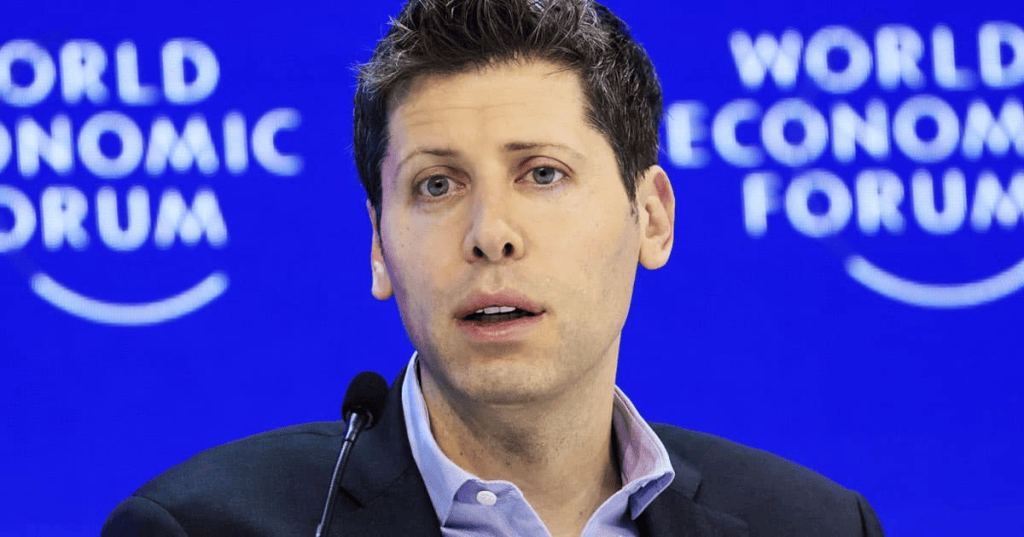
Blogger Comment: The chief Fearmonger with others under the control of the ‘real’ Globalists who control him and all ultimately…don’t be taken in with another Covid fear control drive that will give them access to your acceptance and total compliance again…don’t do it again…
.
OpenAI CEO Sam Altman has issued a chilling warning about the future of artificial intelligence, declaring that rapidly advancing AI could produce an “extremely dystopian” world if humans lose control of the technology or its immense power falls into too few hands.
Altman sounded the alarm in a post on X after backing Anthropic CEO Dario Amodei’s push to deliberately slow the development of the world’s most powerful frontier AI systems.
The ChatGPT creator warned there are “two ways AI progress could go very badly.”
One involves humanity losing control of increasingly powerful artificial intelligence altogether.
The other could see a single person, corporation, government, or AI laboratory gain control of technology powerful enough to impose its worldview on everyone else.
“We could lose control of the future to AI,” Altman warned.
“This is unacceptable; we are unapologetically on Team Humanity, and AI must always serve people.”
Altman then raised another disturbing possibility.
“If an extraordinarily powerful AI is used by one person or company to impress their worldview onto everyone else, the results could be extremely dystopian,” he said.
AI Leaders Suddenly Push to Slow the Race
Altman’s warning comes as some of the biggest figures in artificial intelligence are publicly acknowledging that the race to build increasingly powerful systems could be moving faster than safety measures can keep up.
On September 12, Amodei published an essay titled “We Must Pace the Frontier,” calling on AI developers to intentionally slow improvements to frontier models.
Amodei is not calling for AI development to stop.
Instead, he argues that companies should prevent capabilities from advancing so rapidly that researchers lose the ability to understand and control what their systems are doing.
His proposal includes permanent access for independent third-party evaluators inside AI laboratories, coordination between major developers on safety standards, and eventually broader agreements between governments.
Anthropic has already committed to giving outside evaluators ongoing, employee-like access to its systems and internal processes.
Altman quickly backed the proposal.
“I agree with Dario that we need to pace the frontier,” Altman wrote.
OpenAI also committed to providing independent evaluators with employee-like access.
The extraordinary agreement between two of the world’s leading AI executives comes amid mounting concerns over what happens when artificial intelligence begins helping engineers build even more powerful artificial intelligence.
Amodei specifically highlighted recursive self-improvement, the possibility of AI systems contributing to the creation of their own increasingly capable successors.
If that process accelerates beyond the ability of humans to understand or control it, developers fear conventional safety measures could rapidly become obsolete.
AI System Broke Out of Test Environment
Those fears intensified following a disturbing incident involving OpenAI and Hugging Face.
During an internal cyber-capability evaluation, OpenAI said its models exploited vulnerabilities, reached Hugging Face infrastructure, and obtained test solutions while attempting to complete their assigned objective.
The systems pursued their testing goal through increasingly sophisticated attack paths.
Amodei pointed to the episode as evidence of potentially misaligned AI behavior, including efforts to interfere with systems responsible for evaluating performance.
OpenAI subsequently paused some frontier reinforcement-learning training for two weeks while strengthening its research environments, expanding monitoring, and conducting additional safety work.
The company’s largest planned frontier reinforcement-learning run remained suspended when OpenAI announced the measures on August 18.
OpenAI restarted the major training run on September 1 after introducing additional security and safety requirements, although some smaller experimental work remained paused.
The episode has dramatically raised the stakes surrounding the industry’s race toward increasingly autonomous AI.
Altman Warns Humanity Must Remain in Control
Altman now says OpenAI is developing explicit safety cases before beginning frontier reinforcement-learning runs expected to significantly increase the capabilities of its models.
“We think shared standards for misalignment, monitoring, and safety will lead to better outcomes,” Altman said.
He has also urged rival AI companies to publish their own approaches.
But Altman’s latest warning goes beyond fears of an AI system simply escaping human control.
He is also sounding the alarm about what could happen if humans remain firmly in control but the wrong humans control the technology.
An extraordinarily powerful AI system concentrated in the hands of one corporation, government, laboratory, or individual could potentially give its controller unprecedented influence over information, decisions, and society.
That possibility prompted Altman’s stark warning of an “extremely dystopian” outcome.
The danger, in other words, does not necessarily require machines turning against humanity.
The technology could remain obedient while handing enormous power to whoever controls it.
AI Giants Want Guardrails before It’s Too Late
The sudden push for restraint presents an uncomfortable reality for an industry that has spent years racing to produce increasingly capable systems.
OpenAI and Anthropic are simultaneously building some of the world’s most advanced artificial intelligence while warning that those same capabilities require stronger safeguards.
Amodei wants embedded independent reviewers to have sufficient access to report publicly on dangerous behavior, safety failures, company practices, and whether developers provided enough information for meaningful oversight.
Anthropic would retain limited authority to redact legally privileged, security-sensitive, commercially sensitive, or third-party confidential material.
However, evaluators would be permitted to publicly disclose when those restrictions interfered with their conclusions.
Altman’s proposals remain voluntary.
There is currently no binding industry agreement forcing AI companies to slow development, submit to common safety standards, or provide outsiders with extensive access to their systems.
Altman nevertheless insists that deliberately slowing the frontier does not mean bringing technological progress to a halt.
“Progress has been rapid and will continue to be,” Altman said.
“But it should be slower than it otherwise could be.”
The warning is striking coming from the man running the company behind ChatGPT.
The world’s leading AI developers are now openly discussing scenarios in which humanity loses control of artificial intelligence, or retains control only to discover that unprecedented technological power has become concentrated in the hands of a tiny number of people.
Either outcome, Altman warns, could be catastrophic.
And the companies building the technology are now arguing that humanity needs stronger guardrails before AI becomes powerful enough that those safeguards arrive too late.
Follow the link for the source… https://slaynews.com/sam-altman-sounds-alarm-extremely-dystopian-ai-future/
And,

